
Walk through any fragrance marketplace and you will see the words natural and organic everywhere. Many people associate these terms with something simpler, safer, and more in tune with the body.
That instinct makes sense. In perfumery, however, these words do not always carry those meanings.
Why “natural perfume” feels like the right choice
People who search for a natural perfume usually want something they can trust.
They often look for:
- fewer unknown ingredients
- a more skin-friendly experience
- a sense of authenticity
These goals make sense. The term natural perfume, however, does not have a strict definition, and it does not guarantee any of those outcomes.
The problem with the term “natural perfume”
Perfumers use natural to describe materials that come from plants such as essential oils, absolutes, and extracts. These materials play a central role in the craft.
Many people overlook their complexity.
Each natural material contains a mixture of many chemical compounds. Each compound contributes to the overall scent.
This leads to an important distinction:
- Natural does not mean simple
- Natural does not automatically mean safer
How natural perfume ingredients are actually made
When someone describes a fragrance material as natural, they usually refer to its origin. That origin may be a flower, leaf, resin, or wood.
The extraction process receives far less attention.
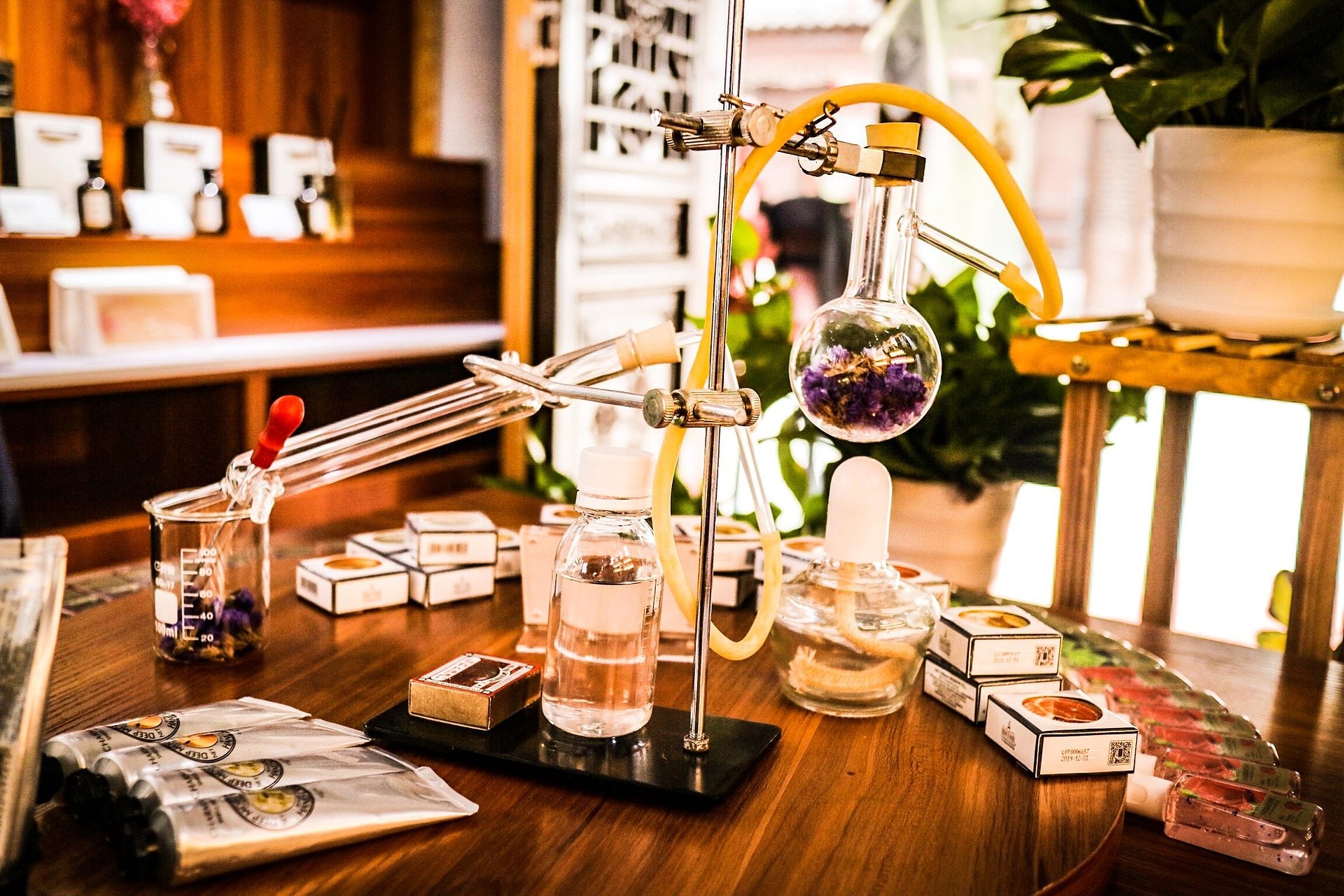
Producers rely on technical methods to isolate aromatic compounds. These methods include steam distillation, solvent extraction, and CO₂ extraction. Each method targets specific scent-bearing components of the plant.
For example, producers create a rose absolute by using a solvent to pull aromatic compounds from petals. They then refine the extract to remove waxes. The final material smells rich and complex. It does not resemble crushed petals in a bottle.
Natural describes origin, not process.
A simple example: rose
Rose shows this complexity clearly.
Many people view rose as a classic natural perfume ingredient. It offers nuance and depth.
A natural rose oil contains hundreds of individual compounds. Some exist in trace amounts, yet they still shape the scent. These compounds include known fragrance allergens such as geraniol, citronellol, and eugenol.
A perfumer can also build a rose accord with a small number of carefully chosen aroma molecules. This approach creates a composition that is easier to control and understand at a chemical level.
Natural materials do not guarantee simplicity or a lower chance of reaction.
What price can tell you about natural perfume
Price offers a useful starting point when you evaluate fragrance materials.
Rose essential oil ranks among the most expensive materials in perfumery. Producers need large quantities of petals to produce a small amount of oil. The process requires significant labor.
At the same time, you will find many products labeled “rose essential oil” at very low prices. Some of these products also use terms like “pure” or “natural.”
Low pricing does not always indicate intentional misrepresentation. Some products use dilution, blending, or constructed compositions that recreate the scent of rose at a lower cost.
Labels alone do not explain how a material is made or what it contains.
Why price alone is not the full picture
Price can provide clues, but it does not tell the full story.
Some materials cost more because of the resources required to produce them. Very low prices can signal differences in composition.
High prices do not guarantee a carefully constructed fragrance. Many products made with pre-blended fragrance oils sell at prices similar to finished perfumes.
Brands set prices based on many factors. These include presentation, positioning, and perceived value, not just material cost.
You need more than price to understand a fragrance.
What about fragrance oils?
Suppliers create fragrance oils as pre-blended scent compositions. Makers then use them as finished materials.
Suppliers protect these formulas as proprietary blends. They provide safety documentation, but they do not disclose full compositions or proportions.
Many makers choose fragrance oils because they simplify the process of creating scented products. This approach limits control over the final structure.
Suppliers often include descriptive language such as “pure” or “natural.” That language can carry into finished product descriptions over time.
This pattern reflects how information moves through the supply chain.
Three different approaches to perfume
You can understand perfumery more clearly by looking at three common approaches:
1. Pre-blended fragrance oils
- Fixed composition
- Limited visibility into materials
- Designed for ease of use
2. Natural perfume materials such as essential oils and absolutes
- Complex compositions
- Derived from botanical sources
- Variable based on origin and extraction
3. Constructed perfumes from individual materials
- Built from raw components
- Greater control over composition
- Clearer understanding of structure
Each approach serves a purpose. The key difference lies in control and transparency.
Natural vs synthetic perfume is not a simple divide
Modern perfumery uses both natural extracts and aroma molecules.
Perfumers combine these materials to refine structure, improve consistency, and shape how a fragrance wears.
If you are curious how this feels in practice, a clean skin scent like Aria shows how a small number of materials can create a soft, natural effect on the skin.
A more intentional approach
At Exuma Fragrance Co., we build each fragrance from individual materials. We use essential oils, absolutes, and aroma molecules together.
In many compositions, natural materials form the core. We use supporting materials such as musks or salicylates to shape structure, extend wear, and refine the scent.
Some fragrances lean more heavily on natural materials. Others use a balanced mix to achieve clarity and stability. Head Shop follows a fully natural structure, while other fragrances use a combination of materials to achieve the intended result.
For a more grounded, nature-forward composition, something like Woodland shows how natural materials can take the lead while still benefiting from careful construction.
We do not aim to match a label. We aim to create a fragrance that feels complete.
How to choose a natural perfume more clearly
If you want to choose a fragrance with confidence, look beyond simple labels.
Ask questions such as:
- Does the brand explain how it creates its fragrances?
- Does it describe materials clearly?
- Does it focus on transparency rather than marketing language?
These questions give you a clearer understanding of what you are wearing.
“Natural perfume” can offer meaning, but it does not guarantee simplicity or safety.
Fragrance comes down to composition. The more clearly a perfumer understands that composition, the more intentionally they can shape it.
That is where the real difference lies.
If you want to explore different styles before committing, you can start with a sample set and experience how these materials wear on your own skin.